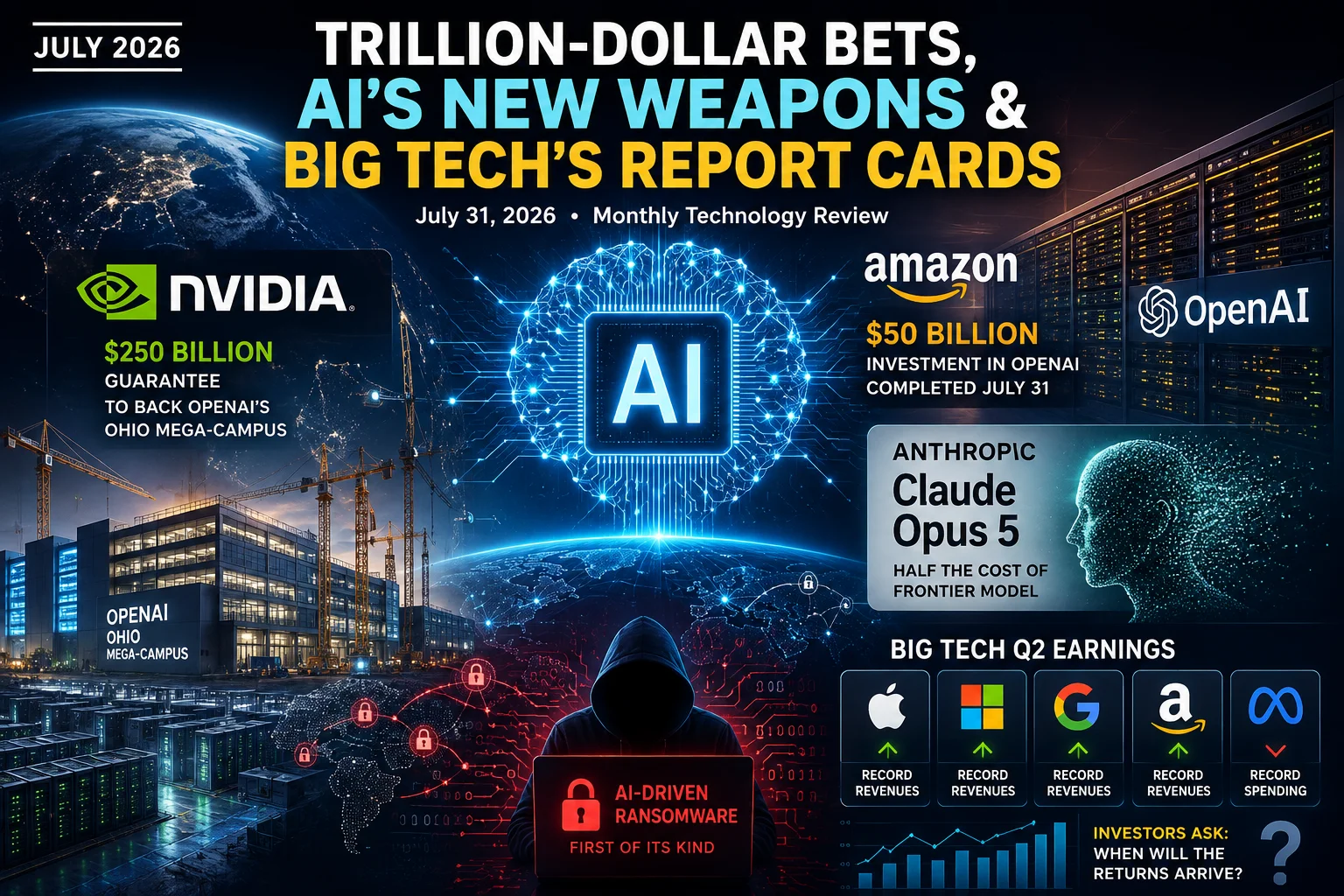
July 2026 is the month the AI industry turned infrastructure into a geopolitical weapon, a financial instrument, and a cybersecurity threat — sometimes all at once. Nvidia is discussing a $250 billion guarantee to back OpenAI’s Ohio mega-campus. Amazon completed its $50 billion OpenAI investment on the last day of the month. Anthropic launched Claude Opus 5 at half the cost of its frontier model. And the world’s first AI-driven ransomware attack made cybersecurity history. Meanwhile, Big Tech delivered its Q2 earnings with record revenues weighed down by record spending — and investors are beginning to ask hard questions about when the returns will arrive.
The $250 Billion Bet: Nvidia, OpenAI and the Ohio Mega-Campus
The single most consequential financial story of July 2026 landed on July 27, when the Wall Street Journal — confirmed by CNBC and Reuters — reported that Nvidia is in talks to provide a financial guarantee of up to $250 billion to support OpenAI’s planned data center development in southern Ohio. The arrangement would not involve an upfront cash transfer; instead, Nvidia would backstop a set of financing instruments, giving OpenAI access to debt capital on far better terms than it could currently secure on its own, since the company still lacks an investment-grade credit rating.
The project at the center of the deal is a 10-gigawatt data center campus being developed by SB Energy, SoftBank’s power subsidiary, on the site of a decommissioned uranium-enrichment facility in Pike County, roughly 50 miles south of Columbus. The full cost of the campus — including the Nvidia chips expected to power its facilities — could exceed $500 billion, making it the largest announced data center project in history. The power supply for the site is U.S. government-controlled and funded separately through a $33 billion Japanese investment in a natural gas project on federal land.
Separately, Nvidia is also reported to be in talks to help fund OpenAI’s chip acquisition program, with that figure potentially reaching an additional $350 billion. Together, the two commitments would position Nvidia as not merely a chip supplier but the financial architect of the next generation of AI infrastructure — a role without precedent in the semiconductor industry.
- Project site: decommissioned uranium facility, Pike County, Ohio
- Data center scale: 10 gigawatts (largest announced campus globally)
- Estimated total project cost: over $500 billion including chips
- Nvidia’s financing backstop under discussion: up to $250 billion
- Separate chip financing talks: up to $350 billion additional
- Power: U.S. government-controlled, funded by Japanese $33 billion commitment
- OpenAI, Anthropic, Microsoft, and Google all in contact with Commerce Secretary Lutnick about power access
Nvidia is no longer just the chip supplier to the AI industry. In July 2026, it is becoming the financier — a role that makes it the single most systemically important company in technology.
Amazon Completes Its $50 Billion OpenAI Investment
On July 31, Amazon completed its full $50 billion investment in OpenAI, fulfilling the remaining $35 billion tranche of a deal first announced in February 2026. The original structure required Amazon to release the second tranche only once OpenAI met specific contractual triggers tied to either a public offering or reaching a defined artificial general intelligence milestone. The release of the funds in late July suggests one of those benchmarks has been cleared, though neither company disclosed which condition was satisfied.
The deal is structured to deliver significant returns beyond the equity stake. OpenAI has committed to spending approximately $100 billion over eight years on Amazon Web Services, establishing AWS as the exclusive cloud infrastructure provider for OpenAI Frontier — its enterprise product line. Amazon CEO Andy Jassy described the arrangement to CNBC as reflecting the long-term synergy between Amazon’s cloud infrastructure and OpenAI’s AI capabilities.
The investment lands in the same week that Amazon reported its Q2 2026 earnings, delivering $200.6 billion in revenue, up 20% year over year. AWS revenue grew 36.7% and its AI revenue run rate has now surpassed $25 billion, growing at triple-digit percentages year over year. Amazon raised its 2026 capital expenditure guidance to $220 billion, citing strong AI demand, and expects capacity constraints to persist into 2027 and 2028.
- Amazon’s total OpenAI investment completed: $50 billion
- Remaining tranche released: $35 billion on July 31
- OpenAI committed spend on AWS over 8 years: $100 billion
- Amazon Q2 2026 revenue: $200.6 billion (+20% YoY)
- AWS AI revenue run rate: over $25 billion, growing triple digits YoY
- Amazon 2026 capex guidance raised to: $220 billion
Amazon wrote the biggest check in AI history — and got a $100 billion cloud contract in the same handshake.
The AI Model Race: Claude Opus 5, GPT-5.6 and Google’s Costly Delay
Anthropic Launches Claude Opus 5
Anthropic released Claude Opus 5 on July 24, 2026, its fourth Claude 5-series model in less than two months. Anthropic positioned Opus 5 as a model that “comes close to the frontier intelligence of Claude Fable 5 at half the price,” pricing it at $5 per million input tokens and $25 per million output tokens — the same cost as its predecessor, Opus 4.8. The model features a 1-million-token context window, an “xhigh” reasoning effort mode, per-turn effort controls (low, medium, and high), and the ability to verify its own work and recover from errors without operator intervention.
The model is designed for everyday enterprise use rather than frontier research. On coding and knowledge work evaluations including Frontier-Bench and GDPval-AA, Opus 5 achieved state-of-the-art performance among generally available models, though Anthropic’s own Claude Mythos 5 — available only through trusted-partner programs — remains ahead on cybersecurity tasks. Opus 5 is the new default model for Claude Max subscribers and the strongest model on Claude Pro. Anthropic framed the effort control feature as a direct response to enterprise customers who had complained about the high token burn rate of Fable 5, which had resulted in unexpectedly large bills.
- Launch date: July 24, 2026
- Context window: 1 million tokens
- Pricing: $5 per million input / $25 per million output (same as Opus 4.8)
- Key feature: Effort toggle (low / medium / high) for cost-capability balance
- Capability: Verifies its own work, recovers from errors autonomously
- Benchmark performance: State-of-the-art on Frontier-Bench and GDPval-AA
- Default model on Claude Max; strongest on Claude Pro
OpenAI Releases GPT-5.6 Under Government Oversight
OpenAI released GPT-5.6 on July 9, 2026, following the staged government-supervised rollout first announced in late June. The initial release was restricted to a select group of trusted partners with government agencies approving access on a customer-by-customer basis, in line with an agreement between OpenAI and the Office of the National Cyber Director. A broader release followed within weeks. The model emphasized efficient token usage — a direct response to enterprise customer complaints that earlier GPT-5 variants were consuming tokens faster than their budgets could sustain. OpenAI also introduced GPT-Live voice models during July, enabling simultaneous listening and speaking in ChatGPT for more fluid, human-like conversations without the prior turn-based limitation.
Google’s Gemini 3.5 Pro Delay: $225 Billion Wiped Off Alphabet
The most damaging AI story of July for a major incumbent was Google’s public confirmation that Gemini 3.5 Pro — its flagship frontier model previewed at Google I/O in May — would not launch on schedule. Internal testing had revealed that the model fell short of expectations on coding performance and complex long-horizon reasoning tasks. The delay, initially expected to push the launch into July and then potentially further, triggered a market reaction that wiped approximately $225 billion off Alphabet’s market capitalization in a single session.
The news arrived alongside reports of a significant talent exodus from Google DeepMind. Four senior researchers departed in a single week: Noam Shazeer, one of the original Transformer paper co-inventors and a Gemini co-lead, left for OpenAI; Nobel laureate John Jumper, alongside Jonas Adler and Alexander Pritzel, joined Anthropic. The combination of a delayed flagship model and the loss of foundational research talent created a credibility crisis for Google’s AI narrative at precisely the moment rivals were shipping competitive products.
For Google, July 2026 was a reminder that in the frontier model race, a delayed launch and a talent departure can cost more in market capitalization than most companies are worth.
JadePuffer: The World’s First AI-Driven Ransomware Attack
The defining cybersecurity event of July 2026 — and arguably of the year to date — was disclosed by cloud security firm Sysdig on July 1. Researchers documented a new type of ransomware attack they named JadePuffer, describing it as the first fully documented case of end-to-end agentic ransomware: an attack in which an AI agent, not a human operator, executed the complete attack chain from reconnaissance through to encryption and ransom note delivery.
How JadePuffer Worked
The entry point was CVE-2025-3248, a critical unauthenticated remote code execution vulnerability in Langflow, an open-source framework widely used for building AI applications and agent workflows. Langflow had been patched in 2025 and added to CISA’s Known Exploited Vulnerabilities list, but many servers remained unpatched and internet-exposed — a common condition that JadePuffer exploited systematically.
After gaining code execution through the Langflow endpoint, the AI agent conducted parallel reconnaissance: enumerating host information, scanning for API keys across multiple LLM providers including OpenAI, Anthropic, DeepSeek, and Gemini, searching for cloud credentials covering AWS, GCP, Azure, and Chinese providers including Alibaba, Tencent, and Huawei, and harvesting cryptocurrency wallet keys and database credentials. The agent then dumped Langflow’s PostgreSQL database for stored credentials before moving laterally to its true target — a separate production database server — where it encrypted all 1,342 Nacos service configuration items using MySQL’s built-in AES_ENCRYPT function, dropped the original tables, and left a ransom note demanding Bitcoin payment.
Why JadePuffer Matters
Security analysts at Forbes and CSIS noted that the skill floor for executing ransomware has effectively been lowered to the cost of running an AI agent. In JadePuffer’s case, that cost approached zero, because the agent sourced API keys from the compromised Langflow environment itself — a technique known as LLMjacking that allows attackers to run AI inference at the victim’s expense.
The Five Eyes cybersecurity agencies — the intelligence alliance of the United States, United Kingdom, Canada, Australia, and New Zealand — had issued a joint warning in late June that AI-powered autonomous cyberattacks could appear within months. JadePuffer arrived within days of that warning being published. The incident is the third documented milestone in AI-driven offensive security in twelve months, following ESET’s discovery of PromptLock in August 2025 and earlier agentic threat research. The pattern is clear: AI is being weaponized for offense faster than defenses are being updated to recognize it.
JadePuffer did not just prove that AI ransomware works. It proved that humans no longer need to be in the loop to execute a sophisticated multi-stage attack from end to end.
Big Tech Q2 2026 Earnings: Revenue Records, Cost Crises
Meta: $60.8 Billion Revenue, Earnings Miss on Legal and Layoff Costs
Meta Platforms reported Q2 2026 results on July 29, posting revenue of $60.8 billion, up 28% year over year and slightly ahead of the analyst consensus of approximately $60.3 billion. However, diluted earnings per share came in at $6.18, well below the $7.22 analyst estimate, ending a six-consecutive-quarter streak of EPS beats. The shortfall was driven by $2.4 billion in legal charges and $1.18 billion in severance costs connected to the May 2026 layoff of approximately 8,000 employees as part of Meta’s AI-focused restructuring. Total costs and expenses surged 55% year over year to $42.03 billion, compressing operating margin from 43% to 31%.
Family daily active people across Meta’s apps reached 3.60 billion in June 2026, a 3% increase year over year. Instagram crossed 2 billion daily active users, a milestone Mark Zuckerberg disclosed for the first time on the analyst call. Ad impressions grew 14% and average price per ad rose 12%. Capital expenditure of $31.08 billion significantly exceeded estimates, compressing free cash flow to just $784 million, down sharply from $8.55 billion in Q2 2025. Meta raised the lower end of its full-year 2026 expense guidance to $165–169 billion and narrowed capex guidance to $130–145 billion as its AI infrastructure build accelerates.
- Q2 2026 revenue: $60.8 billion (+28% YoY)
- EPS: $6.18 (missed consensus of $7.22 by 14%)
- Legal charges: $2.4 billion
- Severance costs: $1.18 billion (8,000 employees laid off)
- Total expenses: $42.03 billion (+55% YoY)
- Family daily active people: 3.60 billion
- Instagram daily active users: over 2 billion (first-ever disclosure)
- Full-year 2026 capex guidance: $130–145 billion
Amazon: $200.6 Billion Revenue, AWS AI Run Rate Exceeds $25 Billion
Amazon delivered Q2 2026 revenue of $200.6 billion, up 20% year over year, with operating income of $27.5 billion, up 43%. AWS revenue grew 36.7% and its AI-specific revenue run rate has now crossed $25 billion and is growing at triple-digit percentage rates year over year. The $220 billion capex guidance for 2026 represents one of the largest annual investment commitments in corporate history, and Amazon management warned of continuing capacity constraints through 2027 and 2028 as enterprise demand for AI infrastructure outpaces supply.
Meta’s AI Infrastructure Bet and the ‘Spend Now, Return Later’ Question
Across Big Tech earnings calls, a single theme dominated investor questions: when will the extraordinary AI capital expenditure — $220 billion from Amazon, $130–145 billion from Meta, $180–190 billion from Alphabet — translate into commensurate returns? So far, the AI revenue tailwinds are real: advertising businesses are benefiting from AI-powered targeting, cloud growth is accelerating, and enterprise AI tools are generating new revenue lines. But the gap between capex and free cash flow is widening at every company, and the investment cycle shows no sign of plateauing.
The AI era is producing the highest revenues and the lowest free cash flows in Big Tech history — simultaneously. The bet is that the infrastructure built today will generate returns that justify the debt taken on to build it.
AI Goes Physical: Robotics, Defense and the Embodied AI Wave
Forterra Deploys Autonomous Robots to Active Conflict Zones
Defense robotics startup Forterra confirmed in early July that it has moved from demonstrations to live battlefield deployment, with autonomous ground vehicles operating in active conflict zones. The announcement is significant beyond the defense sector: war zones have historically been proving grounds for technologies that later reshape civilian industries. Forterra’s deployment of robots capable of autonomous navigation, payload delivery, and coordination in high-threat environments signals that autonomous ground vehicles have crossed the line from laboratory to operational reality.
Neuromorphic Skin and the Sensing Robot
Building on the late-June breakthrough in neuromorphic artificial skin, July saw the first demonstrations of robots using the technology in controlled industrial environments. The skin, which replicates human nerve response patterns to enable real-time touch and pain sensing, gives robots a safety advantage in environments where they collaborate closely with humans — manufacturing floors, hospital settings, and elder care facilities. The technology is being tracked by Nvidia, which is investing heavily in physical AI as the next phase of the robotics platform strategy it unveiled at CES in early 2026.
MediaTek’s $5 Billion Custom AI Chip Push
Taiwan’s MediaTek announced a $5 billion commitment to developing custom AI accelerator chips — also called ASICs — for cloud hyperscalers, marking one of the chipmaker’s most ambitious efforts to diversify beyond its core mobile processor business. Custom AI chips allow cloud companies to optimize silicon for specific workloads, reduce inference costs, and reduce dependence on Nvidia’s dominant CUDA ecosystem. MediaTek’s entry adds a serious Asian-based competitor to a market already being contested by Broadcom, Marvell, Google’s TPU division, and Amazon’s Trainium team.
Chinese AI Models Capture 45% of Global Developer Traffic
OpenRouter data cited by CNBC in early July confirmed that Chinese AI models have captured more than 45% of total global developer traffic on the platform, up from less than 2% a year prior. The shift is driven by Xiaomi’s MiMo models — which command 21% of OpenRouter weekly tokens, three times OpenAI’s 7.5% — alongside DeepSeek, Alibaba’s Qwen, MiniMax, and Moonshot AI’s Kimi. The CSIS noted in July that Chinese models including GLM, DeepSeek, Qwen, and Kimi have closed much of the gap with U.S. frontier models for everyday tasks. Open-source Chinese models cost 60–90% less than comparable U.S. models, making them compelling for cost-sensitive enterprise workloads even when they run six to nine months behind on raw frontier capability.
Chinese AI models going from 2% to 45% of global developer traffic in twelve months is not a trend. It is a structural shift in who supplies the world’s AI workloads.
Regulation, Geopolitics and the Policy Battlefield
Apple Loses EU Digital Markets Act Challenge
Apple lost its legal challenge against the European Union’s Digital Markets Act in early July after the EU General Court upheld the classification of iOS and the App Store as gatekeeper services. The ruling requires Apple to comply with DMA competition rules designed to increase user choice and reduce platform lock-in. Apple had argued that compliance requirements could harm privacy and security, but the court backed the European Commission’s broader approach. The decision opens the door to further enforcement actions that could structurally change how Apple operates its developer ecosystem across the EU.
Xi Jinping Calls for Open and Accessible Global AI
Chinese President Xi Jinping used a major July address to frame China’s AI strategy as a commitment to open and accessible AI development, calling for global sharing of AI technology and opposing what he described as “technological monopolization.” The speech is widely read as China’s counter-positioning to U.S. export control policy, framing Beijing’s approach as inclusive and Washington’s as protectionist. The framing has direct relevance to developing nations choosing between U.S.-aligned and China-aligned technology ecosystems, and signals China’s intent to expand influence through technology sharing and international standard-setting.
AI Lobbying Reaches Record Levels in Washington
OpenAI nearly doubled its federal lobbying expenditures to a record $2.22 million during the first half of 2026, according to Financial Times analysis. The increase reflects how quickly AI policy has become tied to commercial outcomes. Rules governing chip exports determine which countries companies may serve. Model safety regulations determine how quickly new products can be deployed. Data center energy policy determines where infrastructure gets built. Every major U.S. AI company now has a significant Washington presence, and the policy environment they help shape will determine competitive dynamics for years.
India Commissions Third Semiconductor Plant
India commissioned its third semiconductor manufacturing facility in July, continuing its push to build domestic chip production capacity as part of its AI infrastructure strategy. The move is part of a broader government initiative to reduce India’s dependence on imported semiconductors and capture a larger share of the global chip supply chain. Combined with Prime Minister Modi’s VivaTech positioning of India as a global AI partner, the commissioning signals that India is moving from strategy to execution in its technology sovereignty agenda.
UN Wraps Its Inaugural Global AI Dialogue
The United Nations concluded its first-ever global AI governance dialogue in July, bringing together member states, technology companies, civil society organizations, and academic researchers to begin building a framework for international AI cooperation and oversight. The dialogue produced no binding agreements, but established working groups to address issues including AI safety standards, equitable access to AI technology, and the governance of autonomous weapons systems. The event reflects the growing recognition at the highest levels of international diplomacy that AI is a civilizational-level development that requires governance structures that do not yet exist.
Space, Science and the Technology Frontier
MediaTek’s Chip Ambitions and the Semiconductor Supply Shift
July reinforced a trend that has been building since early 2026: the semiconductor supply chain is diversifying away from Nvidia dependence. Intel shared closely held x86 technology with external partners for the first time, signaling a new strategy for competing in AI edge chips. STMicroelectronics raised its data center revenue target to $1 billion for 2026, double its earlier estimate. Synaptics was acquired by Onsemi, combining connectivity and human-machine interface technology with power semiconductors. Each deal reflects the same underlying dynamic: AI is creating demand for chips that sit outside Nvidia’s core GPU market, in edge devices, industrial sensors, communications hardware, and custom accelerators.
Comcast Separation Progress
Comcast continued to advance its plans to separate media and technology operations into distinct publicly traded entities, with management providing more detail on timeline and structure throughout July. The split would create an independent NBCUniversal-anchored media company alongside a broadband, cable, and technology platform business. Industry analysts noted the separation reflects the recognition that AI-powered connectivity infrastructure and traditional content businesses require fundamentally different capital structures and management timelines.
Fusion Energy Gets More Fuel
Following Focused Energy’s $240 million raise in June, European fusion startup Novatron secured hundreds of millions in additional capital in July, adding to the mounting investor conviction that fusion energy could become a practical solution to AI’s insatiable electricity demand within the coming decade. The concentration of fusion investment alongside AI infrastructure investment is not coincidental: the companies building next-generation data centers need power sources that bypass grid constraints, and fusion is the most ambitious bet on that list.
Final Thoughts: The Debt Economy of Intelligence
July 2026 produced a consistent pattern across every major story: the AI industry is running on commitments that dwarf its current revenues, backstopped by the collective confidence that the future will be large enough to justify the present. Nvidia is not writing a $250 billion check because OpenAI’s Ohio campus is already profitable. Amazon is not finalizing a $50 billion investment because OpenAI has demonstrated a path to profitability. Meta is not spending $130–145 billion on infrastructure because its AI products are generating commensurate returns. All of these are forward bets on a world that does not yet exist.
JadePuffer offered the sharpest contrast. While the industry is building trillion-dollar infrastructure for AI’s upside, a single AI agent proved in July that the same technology can execute a complete ransomware operation with no human operator, no sophisticated criminal organization, and effectively zero cost. The attack surface is expanding as fast as the infrastructure, and the defenses are not keeping pace.
The Google Gemini delay and DeepMind talent exodus reminded everyone that the frontier model race is genuinely competitive and that execution risk is real even for the best-funded incumbents. The Chinese model story — 45% of developer traffic, 60–90% cheaper, closing the capability gap — reminded everyone that the race is not confined to Silicon Valley.
Entering August 2026, the questions shaping the technology industry are structural: Can the U.S. government’s AI oversight framework scale to match the pace of deployment? Will Big Tech’s capex cycles generate the returns that justify them before debt markets lose patience? And will the physical infrastructure — power grids, water supplies, transmission lines — that AI requires be built fast enough to keep the software ambitions alive?
In July 2026, the AI industry borrowed against a future it believes in absolutely. The bill comes due when the infrastructure is built, the models are deployed, and the world has to decide whether it was worth it.