From a world-historic IPO filing to Google’s most ambitious developer conference in years, May 2026 is the month the AI economy stopped talking about the future and started trading it on public markets.
A Month That Changed the Scoreboard
April set the price tag for the AI era. May is setting the ticker symbols. The defining story of this month is not a single product launch or funding round — it is the collective rush of the world’s most powerful technology companies toward public markets, at valuations that have no historical precedent. SpaceX filed its S-1. OpenAI prepared its own confidential draft. Anthropic is reportedly pursuing a $900 billion raise. The infrastructure arms race that defined the first half of 2026 has quietly become an IPO supercycle.
| The AI economy is no longer a private affair. In May 2026, it started filing for public markets — all at once. |
The IPO Supercycle Begins
SpaceX Files the Largest IPO in History
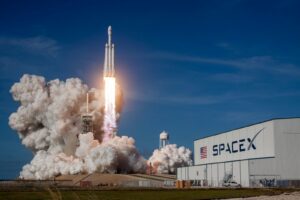
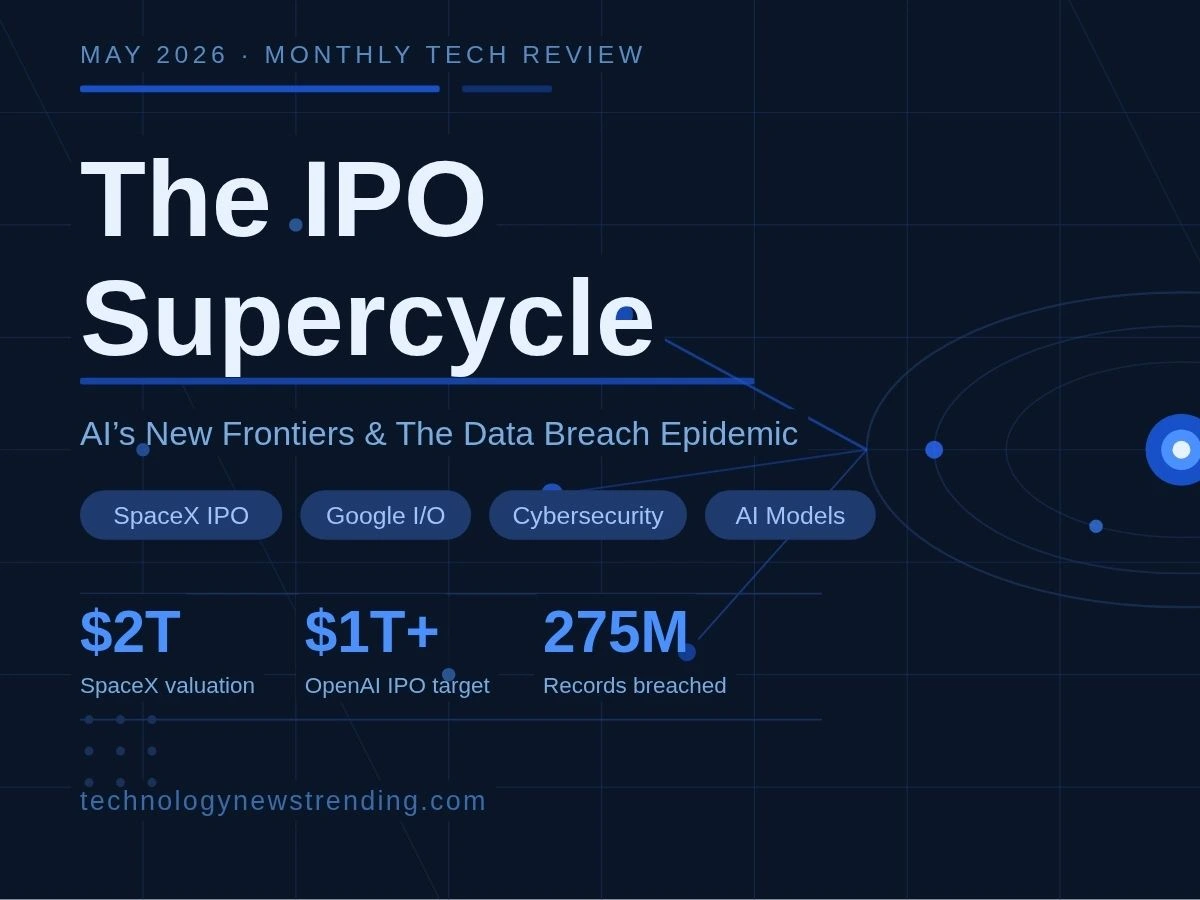
On May 20, 2026, SpaceX filed its S-1 registration statement with the U.S. Securities and Exchange Commission, publicly circulating the audited financials of its combined SpaceX-xAI entity for the first time. The company is listing on Nasdaq under the ticker SPCX, targeting a valuation range of $1.75 trillion to $2 trillion and aiming to raise between $75 billion and $80 billion — a figure that would smash Saudi Aramco’s $29.4 billion record for the largest IPO ever.
The S-1 reveals a company of staggering scale. Starlink accounted for $11.4 billion of 2025 revenue, with 10.3 million subscribers as of Q1 2026, up from 5 million a year prior. But it is the AI segment that commands the most investor attention: SpaceX poured $12.7 billion into AI research and development in 2025 alone, and $7.7 billion in the first quarter of 2026.
The company’s most audacious ambition is orbital data centers. SpaceX plans to begin deploying data center spacecraft in space as early as 2028, and has applied for FCC approval to launch up to one million satellites functioning as an AI compute network above Earth.
- 2025 consolidated revenue: $18.67 billion
- Starlink subscribers: 10.3 million (Q1 2026)
- AI R&D spend: $7.7 billion in Q1 2026 alone
- Roadshow begins June 4; expected listing date June 12
- Elon Musk retains 85% voting control via Class B shares
| SpaceX has identified what it calls the largest actionable total addressable market in human history — $28.5 trillion, dominated by a $26.5 trillion AI opportunity. |
OpenAI Prepares Its Own Trillion-Dollar Filing
Within 24 hours of SpaceX’s S-1 going public, CNBC and the Wall Street Journal reported that OpenAI is preparing a confidential draft IPO prospectus, advised by Goldman Sachs and Morgan Stanley. The company is targeting a public listing as early as September 2026 at a valuation above $1 trillion.
The numbers underpinning the ambition are real. OpenAI closed a $122 billion funding round in late March at an $852 billion valuation, with Amazon committing $50 billion, Nvidia and SoftBank each contributing $30 billion, and $3 billion flowing from individual retail investors. The company now generates $2 billion in revenue per month, with ChatGPT surpassing 900 million weekly active users. Enterprise now accounts for 40% of revenue and is on track to reach parity with consumer revenue by year-end.
The road to profitability remains steep. OpenAI generated $13.1 billion in revenue in 2025 but spent approximately $22 billion to do it. Annual cash burn is projected to reach $57 billion by 2027, with breakeven not expected until 2030.
Anthropic’s Revenue Surge and India Expansion
Anthropic is approaching $19 billion in annualized revenue, up sharply as enterprise adoption accelerates. Business clients now account for roughly 80% of total sales, with over 300,000 firms using Claude tools. Claude Code — the company’s agentic coding product — has already reached nearly $1 billion in annualized revenue since launching earlier this year.
After a Series F led by ICONIQ that valued Anthropic at approximately $183 billion, the company announced plans to open its first office in Bengaluru, India, in 2026, with plans to triple its global workforce. The India expansion signals Anthropic’s intent to compete in one of the world’s fastest-growing enterprise AI markets.
Google I/O 2026: The Year of Gemini 3.5
May 19-20, 2026 — Google used its annual developer conference to make its most aggressive AI product push since the original launch of Android.
Gemini 3.5 Flash and the Agentic Push
The centerpiece of Google I/O 2026 was Gemini 3.5 Flash — a new model that CEO Sundar Pichai described as combining frontier intelligence with action. Positioned as the first in a new generation of action-oriented models, it is priced at roughly half, and in some cases one-third, the cost of comparable frontier models from rivals.
Google also unveiled Gemini Spark, a general-purpose AI agent embedded in the Gemini app that can reason across connected applications and take action on behalf of users. Initially restricted to Google AI Ultra subscribers and trusted testers, Spark represents Google’s answer to the agentic AI wave that OpenAI and Anthropic have been accelerating all year.
Gemini Omni and the Video Generation Race
A second major announcement was Gemini Omni, a model combining Gemini’s reasoning capabilities with advanced content creation tools. The first version, Gemini Omni Flash, allows users to generate and edit video using combinations of text, images, audio, and video prompts — putting Google directly in competition with OpenAI’s video generation tools and specialist providers like Runway and Sora.
Android XR, AI Transparency, and Shopping
Beyond models, Google showcased Android XR smart glasses with spoken assistance and in-lens displays, a Universal Cart shopping system designed to work across Google services, and Antigravity 2.0, a platform for managing autonomous AI agents.
In a notable industry-wide move on AI transparency, Google announced that OpenAI, Nvidia, and ElevenLabs are adopting its SynthID watermarking standard for AI-generated content, signaling growing cross-industry collaboration on provenance and authenticity.
| Google I/O 2026 delivered one clear message: Gemini is no longer catching up — it is competing for the lead. |
Trump’s Gulf Tour: $600 Billion in AI Commitments
In mid-May, President Trump visited Saudi Arabia, Qatar, and the UAE, returning with announcements that are reshaping global AI infrastructure geography. The four-day tour generated approximately $600 billion in commitments to U.S. companies, with AI chips and data centers at the center of nearly every deal.
Nvidia and AMD Land Massive Saudi Deals
Nvidia announced it will sell hundreds of thousands of AI chips in Saudi Arabia, with an initial tranche of 18,000 of its newest Blackwell chips going to Humain, an AI startup launched by Saudi Arabia’s sovereign wealth fund. AMD formed a $10 billion collaboration with Humain, and Qualcomm signed a memorandum of understanding to develop data center processors in the kingdom.
Saudi firm DataVolt simultaneously committed $20 billion to invest in AI data centers and energy infrastructure inside the United States. Google, Oracle, Salesforce, AMD, and Uber pledged a combined $80 billion in investments in both countries.
The UAE Deal: 5-Gigawatt AI Campus
The Trump administration announced plans to build a 5-gigawatt AI campus in Abu Dhabi — sufficient to power millions of Nvidia’s most advanced AI chips — and established a formal U.S.-UAE AI Acceleration Partnership. The administration is also nearing an agreement that would allow the UAE to import 500,000 of Nvidia’s most advanced AI chips per year.
| Analysts described the Abu Dhabi announcement as bigger than all other major AI infrastructure commitments combined — a statement that redraws the map of global AI capacity. |
The AI Model Battlefield
Meta Launches Muse Spark — And Abandons Open Source
Meta launched Muse Spark on April 8, the first AI model from its newly formed Meta Superintelligence Labs under Chief AI Officer Alexandr Wang. The launch marks a dramatic strategic reversal: Muse Spark is fully proprietary, with no open weights — a direct abandonment of the Llama open-source strategy that had accumulated 1.2 billion downloads.
The model was code-named Avocado internally and delivers competitive performance in multimodal perception, reasoning, health, and agentic tasks at significantly lower compute costs than the older Llama 4 mid-size variant. Meta stock rose more than 9% on launch day, the strongest single-session response to a Meta product announcement in over two years. The company plans to open API access to third-party developers in the coming months.
AMD’s Ryzen AI Max 400: Large Models Come to the Device
AMD introduced its Ryzen AI Max 400 ‘Gorgon Halo’ chips, featuring support for up to 192GB of unified memory — enough local memory capacity to run very large AI models entirely on-device, without cloud connectivity. The announcement accelerates the trend of edge AI computing, with implications for privacy-sensitive industries, offline applications, and enterprise deployments.
OpenAI’s $25 Billion Revenue Run Rate
OpenAI is generating $2 billion in revenue per month, placing its annualized run rate comfortably above $25 billion. The company’s newest model, GPT-5.4, is driving growth across agentic workflows, with API processing now exceeding 15 billion tokens per minute. Enterprise revenue is growing at four times the pace that Google or Meta delivered at equivalent stages.
Wayve and Stellantis: AI-First Autonomous Driving
London-based AI startup Wayve and Stellantis announced a partnership to bring AI-first driver assistance technology to mass-market vehicles by 2028. Unlike traditional rule-heavy autonomous systems, Wayve’s approach is entirely learning-based — a validation of end-to-end neural approaches that Wayve’s backers, including Microsoft and SoftBank, have been funding since 2023.
Cybersecurity in May 2026: The Data Breach Epidemic
Instructure Breach: 275 Million Affected
The largest cybersecurity incident of May involved Instructure, the company behind the Canvas learning management system. The ShinyHunters ransomware group claimed responsibility for a breach that affected nearly 9,000 schools, with over 3.65 terabytes of data compromised belonging to an estimated 275 million people, including students, teachers, and staff. The scale of the incident makes it one of the most significant education-sector breaches on record.
Supply Chain Attacks Dominate the Threat Landscape
May continued the pattern established in April: attackers are no longer targeting organizations directly but entering through trusted third parties. Two major U.S. banks were hit through a shared vendor. Adobe was reportedly breached through an Indian BPO contractor. An AI productivity tool became the entry point into a major cloud platform. The Foxconn ransomware attack in mid-May exposed how fragile the global tech supply chain has become at precisely the moment the industry is racing to build next-generation AI infrastructure.
IBM Commits $5 Billion to Open-Source Security
IBM announced a $5 billion commitment to securing open-source software infrastructure, reflecting growing recognition that open-source security is now critical infrastructure for the AI economy. The announcement came as software supply chains face rising pressure from AI-generated code, automated attacks, and the growing dependence of enterprises and governments on shared components.
Brightspeed Telecom Breach and the Crimson Collective
A new aggressive cyber extortion group identifying itself as the Crimson Collective claimed to have stolen data on more than one million customers of telecommunications provider Brightspeed in a ransomware attack. The incident is part of a broader wave of telecom-sector targeting as nation-state actors and criminal groups converge on communications infrastructure.
| Cybersecurity has become AI vs. AI. Attackers use intelligent systems to identify and exploit vulnerabilities; defenders must respond with intelligent systems of their own. |
Geopolitics, Regulation & Trends to Watch
Sam Altman Walks Back the Jobs Apocalypse
OpenAI CEO Sam Altman told an audience in Sydney on May 26 that the rapid rollout of artificial intelligence will not produce the widespread white-collar job losses he once predicted. Altman acknowledged he had been wrong about near-term economic impact, noting that human interaction remains essential across many professional roles and that augmentation — not replacement — has been the dominant pattern in real-world AI adoption so far. The reversal is significant: Altman’s own forecasts have shaped regulatory and public discourse about AI labor displacement.
China Tightens Control Over AI Talent
Amid the intensifying U.S.-China AI rivalry, Beijing has implemented measures to restrict the flow of top AI researchers and engineers to foreign companies. The move mirrors Washington’s own chip export controls and signals a bifurcation of AI talent pools that could shape competitive dynamics in frontier model development for years to come.
Brussels Readies a Nine-Figure Google Fine
European regulators are preparing a major financial penalty against Google related to AI and search market conduct. The fine, expected to reach nine figures, would be the latest in a series of enforcement actions designed to constrain the market power of U.S. AI incumbents in European markets and ensure competitive access to AI-powered services.
Quantum Computing Gets Government Backing
The U.S. government announced it will award up to $2 billion to selected quantum computing companies while taking equity stakes, marking one of the most significant public investments in quantum technology to date. The move follows a broader recognition that quantum computing — particularly quantum cryptography and optimization — will be strategically decisive in the AI era.
Starship’s Twelfth Test Flight
SpaceX scrubbed and then completed the twelfth suborbital test flight of its Starship vehicle in May, with the company confirming that Starship is expected to begin launching commercial satellites in the second half of 2026. The vehicle is central to SpaceX’s orbital data center ambitions and will serve as the backbone of the company’s pitch to public market investors.
Mistral Bets on European AI Sovereignty
French AI company Mistral announced plans for a new 10-megawatt data center in Les Ulis, France, as part of a broader European push for AI sovereignty. Mistral CEO Arthur Mensch also publicly defended the use of AI in defense applications, arguing that Europe requires its own AI capabilities because adversaries are already deploying the technology in military contexts.
Final Thoughts: The Public Market Test
May 2026 will be remembered as the month the AI economy submitted its first report cards to public markets. SpaceX filed; OpenAI followed. The valuations are staggering, the losses are real, and the timelines to profitability are measured in years. What investors are being asked to price is not the present state of these businesses — it is control over the infrastructure of the next twenty years.
Google’s I/O showed that incumbents are not standing still. The Gulf deals showed that AI geopolitics now operate at the scale of sovereign wealth funds and national energy grids. The cybersecurity headlines showed that every new layer of AI capability creates new attack surfaces that criminal and nation-state actors are already exploiting.
The common thread across every story in May 2026 is the same one that ran through April: the AI competition has moved decisively beyond models and benchmarks. It is now a contest over infrastructure, capital markets, regulatory frameworks, and talent — arenas where the stakes are existential and the time horizons are long.
| May 2026 answered April’s question — who controls the pipeline? — with a new one: at what price will the public buy in? |