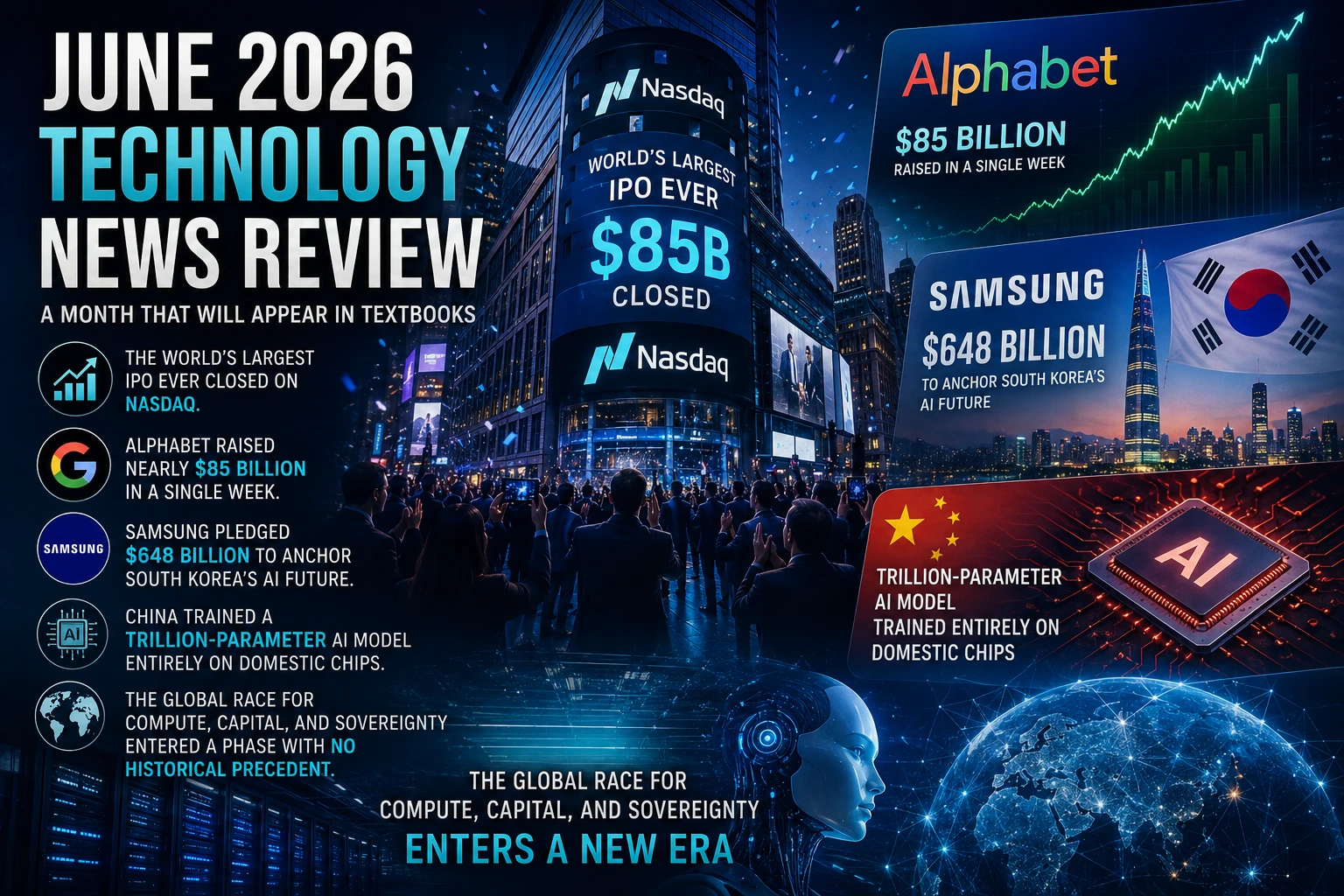
June 2026 is a month that will appear in textbooks. The world’s largest IPO ever closed on Nasdaq. Alphabet raised nearly $85 billion in a single week. Samsung pledged $648 billion to anchor South Korea’s AI future. China trained a trillion-parameter AI model entirely on domestic chips. And the global race for compute, capital, and sovereignty entered a phase with no historical precedent.
The Month That Broke Records
When historians look back at the AI era, June 2026 will mark the moment the technology stopped being measured in benchmarks and started being measured in market capitalizations. SpaceX went public at a valuation that made its founder the world’s first trillionaire. Alphabet raised more money in a single equity offering than the entire U.S. IPO market did in all of 2025. Samsung committed to a decade of investment larger than the GDP of most nations. These are not incremental steps. They are tectonic shifts in who controls the infrastructure of the next economy.
June 2026 did not just set records. It redefined what a record looks like in the AI era.
The SpaceX IPO: History on Nasdaq
June 12: Trading Begins on the Largest IPO Ever
SpaceX began trading on the Nasdaq on June 12, 2026, under the ticker symbol SPCX, after pricing its shares at $135 each the previous evening. The company opened at $150, immediately surging nearly 11%, before climbing further to around $161.75 in early trading. By mid-session on its debut day, SpaceX had reached a market capitalization of approximately $2.1 trillion, positioning it as the sixth most valuable U.S.-listed company, surpassing Broadcom, Saudi Aramco, and Tesla in a single trading session.
The IPO raised $86 billion for the company, comfortably exceeding its initial $75 billion target, after extraordinary investor demand. The roadshow, which kicked off on June 4, reportedly attracted $250 billion in orders — an oversubscription rate of nearly four times the planned offering size. Elon Musk’s net worth crossed $1 trillion as a result, making him the first person in recorded history to reach that threshold.
- IPO price: $135 per share (June 11 close)
- Opening price: $150 on June 12
- Market cap on debut: approximately $2.1 trillion
- Total raised: $86 billion (largest IPO in history)
- Investor demand: $250 billion in orders, 4x oversubscribed
- Elon Musk post-IPO: 42% of shares, 82% of voting power
- Ticker: SPCX on Nasdaq
The Business Behind the Valuation
SpaceX’s S-1 laid out the company’s ambitions with unusual candor. Starlink remains the only reliably profitable segment, contributing $11.4 billion of the company’s $18.7 billion in 2025 revenue, with quarterly revenue of $3.26 billion as of Q1 2026 and a subscriber base projected to grow from 10 million toward 17 million through the year. However, average revenue per subscriber has fallen from $99 per month in 2023 to $66 by Q1 2026, as SpaceX competes in price-sensitive international markets.
The case for the $2 trillion valuation rests primarily on the AI and xAI business. SpaceX’s Colossus data center — housing roughly 220,000 Nvidia GPUs at over 300 megawatts of capacity — is already generating $1.25 billion per month from a lease to Anthropic alone. The S-1 described a total addressable market of $28.5 trillion, including $22.7 trillion for enterprise AI applications and $2.4 trillion for AI infrastructure. Orbital data centers, planned for launch as early as 2028, represent the company’s most audacious long-term bet.
The listing was not without controversy. Senator Elizabeth Warren sent a 12-page letter to the SEC on June 10, requesting a delay, citing concerns about governance, investor protections, and the valuation methodology. Underwriters also barred subscription orders from investors in Hong Kong and China, citing technology export control and regulatory risks. Nonetheless, the IPO closed on schedule, and SpaceX shares reached an all-time high of $225.64 on June 16 before pulling back.
SpaceX’s listing did not just raise $86 billion. It potentially shifted trillions of dollars of institutional portfolio allocation toward a new generation of AI-native public companies.
Alphabet Raises $85 Billion in a Week
The Largest Corporate Equity Raise in History
On June 1, 2026, Alphabet announced plans to raise $80 billion through a combination of equity offerings, instantly becoming one of the largest single capital market transactions in corporate history. The announcement came with an extraordinary anchor: Berkshire Hathaway agreed to invest $10 billion in Alphabet through a private placement, one of the largest single technology investments the Buffett-era conglomerate has ever made, executed under new CEO Greg Abel who had been steadily building Berkshire’s Alphabet stake since Q3 2025.
By June 2, the offering was upsized. After pricing its shares of Class A and Class C common stock, mandatory convertible preferred stock, and at-the-market offerings, the total equity raise reached $84.75 billion. Including underwriter over-allotment options exercised in the days following, the final total reached approximately $90 billion. Goldman Sachs, JPMorgan, and Morgan Stanley managed the syndicate.
The rationale was unambiguous. Alphabet CEO Sundar Pichai told investors at a June 2 presentation that demand for Google’s AI solutions from enterprises and consumers is currently exceeding the company’s available compute supply, and that since launching Gemini 3, hardware and engineering improvements have reduced the cost of core AI responses by more than 30%. The company’s 2026 capital expenditure guidance stands at $180 to $190 billion, with 2027 capex expected to increase significantly further.
- Announced raise: $80 billion (June 1)
- Final raise: approximately $90 billion after upsize and over-allotments
- Anchor investor: Berkshire Hathaway — $10 billion private placement
- Purpose: AI compute infrastructure to meet demand exceeding supply
- 2026 capex guidance: $180–$190 billion
- Google Cloud Q1 2026: strongest quarterly result in company history
Samsung and South Korea: $880 Billion for the AI Decade
On June 28–29, Samsung Group announced a sweeping decade-long investment commitment of 1,000 trillion won — approximately $648 billion — to be deployed across South Korea over the next ten years. The investment plan, unveiled at a meeting with President Lee Jae Myung, includes a potential 300 trillion won push to build semiconductor factories in the country’s southwest, alongside AI data centers, batteries, and displays.
By the time SK Hynix joined the announcement, Bloomberg reported that total South Korean corporate commitments reached at least 1,350 trillion won — approximately $880 billion — from Samsung and SK Hynix combined. The initiative is explicitly designed to turn South Korea’s AI-driven chip boom into a nationwide economic growth engine, decentralizing infrastructure and manufacturing beyond the capital Seoul and into regions that have historically been left behind by the technology industry.
The timing reflects a strategic window. Samsung and SK Hynix are reaping record profits as AI drives insatiable global demand for high-bandwidth memory and advanced logic chips. South Korean policymakers are racing to convert that windfall into durable infrastructure before competitors in Taiwan, Japan, and the United States harden their own advantages.
$880 billion over a decade is not a corporate investment plan. It is a national industrial strategy expressed in private capital.
AI Infrastructure: The Full-Stack Arms Race
Qualcomm Acquires Modular for $3.9 Billion
Qualcomm confirmed on June 25, 2026 its acquisition of Modular, an AI infrastructure startup that built the MAX platform and the Mojo programming language. The deal is valued at approximately $3.92 billion. Modular’s core technology allows developers to write model deployment code once and run it across Qualcomm chips, Nvidia GPUs, Apple Silicon, or cloud TPUs without porting work — a chip-agnostic deployment layer that addresses one of the most persistent friction points in enterprise AI adoption.
For Qualcomm, the acquisition fills a critical gap. The company designs competitive silicon across mobile (Snapdragon) and data center (Dragonfly) markets but has historically lacked the software ecosystem that makes Nvidia’s CUDA platform so defensible. By acquiring Modular, Qualcomm is not just buying technology — it is buying developer relationships and a software moat.
Nvidia RTX Spark: AI PCs Enter the Mass Market
Nvidia’s RTX Spark Superchip, unveiled at Computex in late May, began appearing in vendor line-ups throughout June. Systems from Asus, Dell, HP, Lenovo, Microsoft Surface, and MSI were confirmed to be in development. The chip combines Blackwell RTX graphics with Grace CPU technology in a single package, bringing frontier AI inferencing capability to laptops and mini-PCs without cloud connectivity.
The move puts Nvidia directly into the consumer PC stack for the first time, competing on-device against Apple, Intel, AMD, and Qualcomm. The strategic implication is significant: as AI agents shift from cloud-only to hybrid and local execution, the chip that powers the device becomes as strategically important as the data center GPU.
Data Center Reality Check: 30–50% of Planned U.S. Builds Delayed
A sobering data point emerged in early June: analysis of approximately 140 planned U.S. data centers targeting 16 gigawatts of combined capacity suggests that 30 to 50 percent of those projects may miss 2026 timelines or be canceled outright. The primary bottlenecks are physical, not financial — multi-year waits for power transformers, inadequate grid connections, community opposition over energy and water usage, and local policy reversals.
Ohio suspended a major tax incentive for data centers in June after projected exemption costs surged unexpectedly. Residents began organizing a ballot measure that could ban hyperscale data centers statewide. The political backlash illustrates the growing friction between AI’s infrastructure ambitions and the communities that are expected to host them. Nuclear, on-site generation, and fusion alternatives are receiving renewed attention as AI companies look for power sources that bypass grid constraints.
Rocket Lab Acquires Iridium for $8 Billion
Rocket Lab announced on June 29 that it had agreed to acquire Iridium, the satellite communications company, in a cash-and-stock deal valued at approximately $8 billion. The acquisition combines Rocket Lab’s launch vehicles and satellite manufacturing business with Iridium’s global L-band satellite network, licensed spectrum, and more than 2.5 million subscribers across government, defense, aviation, maritime, and commercial markets.
The deal is Rocket Lab’s largest to date and its first acquisition of a publicly traded company. Rocket Lab framed the acquisition as a solution to three specific challenges in building a satellite communications business: access to spectrum, the long lead time to deploy infrastructure, and the difficulty of generating revenue before coverage is global. Iridium solves all three in a single transaction. Rocket Lab shares rose 16% and Iridium shares surged 25% on the announcement.
Focused Energy: $240 Million for Laser Fusion
Focused Energy raised a $240 million Series A to advance its laser-powered fusion technology, bringing its total private capital to approximately $300 million alongside $200 million in grants. The raise is one of the largest fusion funding rounds in history and reflects a broader shift: as AI data centers drive electricity demand to unprecedented levels, fusion startups have moved from scientific curiosity to strategic infrastructure bet.
The AI Model Battlefield in June
Gemini 3.5 and the Live Translate Breakthrough
Google’s June AI updates were anchored by Gemini 3.5 Live Translate, a real-time spoken language translation tool embedded across Android devices and Google services. The feature, combined with the launch of Android 17 and the Pixel Drop update, represents the most comprehensive monthly AI product rollout in Google’s history. Android 17 introduced floating app windows, Screen Reactions for picture-in-picture recording, enhanced biometric phone locking, and expanded AI-powered video and music creation tools.
Google also launched Gemma 4 12B, an open model capable of running locally on laptops, and introduced a new Google Home Speaker built around Gemini as the primary interface. Sundar Pichai’s June 2 investor presentation confirmed that Gemini 3’s rollout had reduced the cost of core AI responses by more than 30% through hardware and engineering improvements — a competitive pricing signal aimed directly at OpenAI and Anthropic.
China’s LongCat: A Trillion-Parameter Model on Domestic Chips
On June 30, Chinese food delivery giant Meituan announced the release and open-sourcing of LongCat, claiming it is the world’s first trillion-parameter AI language model trained and operated entirely on domestically produced chips. The model was trained on a 50,000-chip computing cluster built entirely from Chinese-made processors, with no Nvidia hardware involved. Meituan stated the model has 1.6 trillion parameters.
The announcement is a direct challenge to U.S. export control strategy. Washington’s restrictions on advanced semiconductor exports to China were premised on the assumption that cutting off Nvidia’s best chips would slow Chinese AI development. LongCat suggests Chinese companies have found an alternative path — building domestic chip clusters at a scale sufficient to train frontier-class models, even if individual chip performance remains below Nvidia’s best. The open-source release amplifies the strategic impact: the model and the proof of concept are now available to any developer worldwide.
LongCat is not just a model. It is a demonstration that China can build frontier AI without Nvidia — and is willing to show the world how.
OpenAI’s GPT-5.6: Government-Gated Rollout
The Trump administration requested that OpenAI limit the initial rollout of its anticipated GPT-5.6 model to a select group of trusted partners, with government agencies approving access customer by customer. OpenAI CEO Sam Altman informed staff of the staggered approach following discussions with the Office of the National Cyber Director and the Office of Science and Technology Policy. A broader public release was expected to follow within weeks if the limited preview succeeded.
The episode reflects a significant shift in how the U.S. government is thinking about frontier model releases. Where earlier administrations treated AI deployment as a private sector matter, the current administration is treating advanced model releases as a national security decision subject to inter-agency review. The move echoes Anthropic’s earlier voluntary restrictions on Claude Mythos, its most powerful unreleased model.
AI and the Jobs Question: The RAISE US Initiative
The June AI employment debate crystallized around two data points. Anthropic’s June 2026 Economic Index Survey of approximately 9,700 users found that over 35% expect AI to perform most or nearly all of their work tasks within 12 months — a striking result that suggests worker anxiety about automation has moved from abstract concern to immediate expectation. Separately, analysis cited by Metaintro found that AI was behind 88,000 U.S. job cuts in 2026, more than all prior years combined.
In response, the RAISE US initiative — co-founded by Sam Altman and former Commerce Secretary Gina Raimondo — entered June with a board that now includes AFL-CIO President Liz Shuler, the first time organized labor has had a formal seat at a major AI workforce transition initiative. Raimondo’s framing was direct: America has a technology strategy for leading the global AI competition. It does not yet have a people strategy, and it cannot lead without one.
Cybersecurity: Infrastructure Under Siege
KDDI Breach: 14.2 Million Email Accounts Exposed
Japanese telecom operator KDDI disclosed in late June that a breach of an email system shared across multiple internet service providers had potentially exposed the login credentials of up to 14.2 million email accounts. The incident is one of the largest telecom-sector data breaches in Japanese history and illustrates the cascading vulnerability of shared infrastructure: a single compromised system servicing multiple ISPs creates a blast radius that multiplies beyond any single provider’s customer base.
Amazon One Medical and the Healthcare Breach Wave
Hackers claiming responsibility for a breach of Amazon’s One Medical healthcare service issued warnings and threats in mid-June after allegedly stealing sensitive patient and administrative data. The breach, reported by Cybernews on June 18, follows a pattern of escalating attacks on healthcare systems, where the value of medical records and the operational disruption from downtime make providers high-value targets for both financially motivated and state-sponsored actors.
Industrial OT Devices: The Lantronix Vulnerability
Security researchers flagged active exploitation of a flaw affecting Lantronix serial-to-IP converter devices — hardware used to connect legacy industrial systems to modern networks. The vulnerability matters because operational technology security remains one of the weakest links in enterprise cyber defense. Factories, utilities, logistics networks, and critical infrastructure routinely rely on equipment that was designed before modern threat actors existed. As AI accelerates vulnerability discovery and automated exploitation, the exposure window for unpatched industrial devices is shortening rapidly.
Cellebrite and the Export Control Problem
A report emerged in June that Russian authorities used Cellebrite phone extraction technology to access a dissident’s device months after the Israeli company had publicly said it was no longer doing business in Russia over human rights concerns. The finding illustrates a persistent and uncomfortable truth about export controls on surveillance technology: commercial tools circulate far beyond the sales relationships that created them, and the gap between a company’s stated policy and the real-world availability of its products can be wide and durable.
Cybersecurity in June made one reality undeniable: the attack surface is now as physical as it is digital, reaching into industrial floors, healthcare systems, and legacy telecoms.
Regulation, Geopolitics & Emerging Trends
EU Digital Sovereignty: The Cloud and AI Development Act
Brussels introduced a broad package to strengthen Europe’s digital sovereignty in June, including a follow-on to the EU Chips Act and a new Cloud and AI Development Act. The legislation aims to reduce European reliance on foreign technology providers while supporting domestic cloud, AI, and semiconductor capacity. The package avoids an explicit ‘Buy European’ mandate but creates regulatory incentives that push European public and private buyers toward locally controlled digital infrastructure.
India at VivaTech: Positioning as a Global AI Partner
Indian Prime Minister Narendra Modi used the VivaTech 2026 conference in Paris to present India as a strategic global partner in AI development. The positioning reflects India’s ambition to capture a share of the AI value chain beyond its traditional strength in software services — moving into model development, AI infrastructure, and data governance as a differentiating sovereign capacity.
U.S. Supreme Court Limits Phone Location Data Sweeps
The U.S. Supreme Court issued a ruling in late June sharply limiting law enforcement’s ability to conduct broad sweeps of phone location data without individualized warrants. The decision is one of the most significant digital privacy rulings in years and has immediate implications for surveillance technology companies, data brokers, and the dozens of government agencies that have relied on aggregated location data for investigative purposes.
Comcast Splits into Two Public Companies
Comcast announced plans to separate its media and technology operations into distinct publicly traded entities, aiming to allow each business to pursue more focused strategies. The media assets — including NBCUniversal — would trade separately from the cable, broadband, and technology platform businesses. The split reflects the growing recognition that the distribution layer of the media business, which is increasingly converging with AI-powered infrastructure and connectivity, cannot be managed on the same strategic timeline as traditional content.
Neuromorphic Skin: Robots That Can Feel
Scientists announced in late June the development of advanced neuromorphic artificial skin that mimics human nerve responses, enabling robots to sense touch and pain and react in real time with high efficiency. The technology represents a meaningful step toward more intuitive and safe human-robot interaction and has direct implications for healthcare robotics, industrial automation, and elder care. It also points toward a broader class of bio-inspired computing hardware that could eventually influence chip and sensor design beyond robotics.
From space-based AI infrastructure to robots that can feel, June 2026 compressed what should have been a decade of technology development into a single month.
Final Thoughts: The New Gravity of Capital
June 2026 will be remembered as the month when AI stopped being a technology story and became a capital markets story. SpaceX’s IPO, Alphabet’s equity raise, Samsung’s $648 billion commitment, South Korea’s $880 billion national initiative — these are not announcements about products or models. They are decisions about where the next era of the economy will be physically built, and who will own it.
The cybersecurity landscape reminded us that every new layer of infrastructure creates new attack surfaces, and that the physical systems connecting AI to the real world — industrial devices, telecoms, healthcare networks — are often the least protected. The regulatory moves in Brussels, Washington, and Seoul showed that governments are no longer passive observers of this transformation. They are active participants, writing the rules that will determine who captures the value.
China’s LongCat model was perhaps the single most strategically significant event of the month, not because it outperformed rival models, but because it demonstrated that the U.S. semiconductor export control strategy may be less effective than its architects hoped. Building frontier AI on domestic chips, at scale, changes the geopolitical calculus in ways that no benchmark score can fully capture.
The question entering July 2026 is no longer whether AI will reshape the economy. It is whether the institutions — governments, regulators, labor organizations, infrastructure operators — that were built for the old economy can adapt fast enough to shape the new one.
June 2026 answered one question clearly: the AI era has a price tag. The harder question is who pays it.