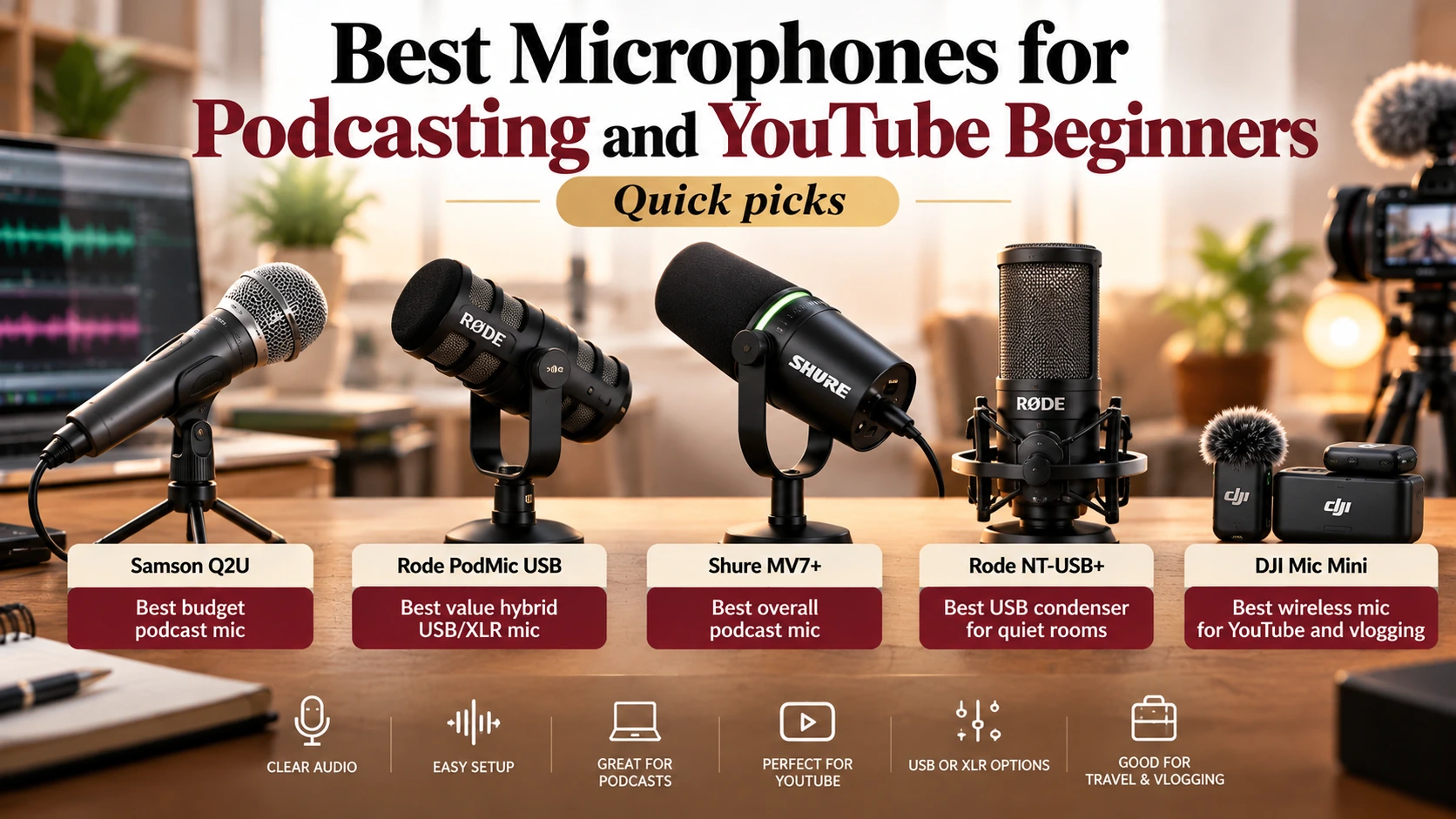
Quick picks
- Best budget podcast mic: Samson Q2U
- Best value hybrid USB/XLR mic: Rode PodMic USB
- Best overall podcast mic: Shure MV7+
- Best USB condenser for quiet rooms: Rode NT-USB+
- Best wireless mic for YouTube and vlogging: DJI Mic Mini
Disclosure: As an Amazon Associate, I earn from qualifying purchases. This costs you nothing extra.
Why your microphone matters more than your camera
Viewers will forgive a slightly soft video, but they click away from echoey, muffled, or noisy audio. Your laptop’s built-in microphone picks up keyboard clatter, fan noise, and room echo, which makes even great content sound amateur.
The good news: a decent microphone costs far less than a good camera, and it’s the single biggest upgrade most new podcasters and YouTubers can make.
This guide explains the different types of microphones, which one suits your room and budget, and how to get great sound at home.
How we chose: We have not tested these microphones ourselves. Our picks draw on hands-on reviews from MusicRadar and other audio publications, manufacturer specifications, and long-standing community recommendations for beginners.
Comparison table
| Microphone | Type | Connection | Best for | Watch out for | Price tier |
| Samson Q2U | Dynamic, cardioid | USB and XLR | First podcast, untreated rooms | Basic build | Budget |
| Rode PodMic USB | Dynamic, cardioid | USB-C and XLR | Solo hosts wanting broadcast tone | Heavy; needs a sturdy boom arm | Mid |
| Shure MV7+ | Dynamic, cardioid | USB-C and XLR | Serious beginners who want easy, polished sound | Pricier | Premium |
| Rode NT-USB+ | Condenser | USB | Quiet, treated rooms | Picks up more room noise | Mid |
| DJI Mic Mini | Wireless clip-on (lavalier) | Receiver for phone or camera | Vlogging, interviews, talking-head videos | No internal backup recording | Budget to mid |
Check live prices on Amazon.
Why audio quality matters: what the research says
Poor audio makes you seem less credible. In a 2018 study published in Science Communication, researchers Eryn Newman (Australian National University) and Norbert Schwarz (University of Southern California) played the same conference talks and radio interviews to participants with either clear or degraded audio. When the sound was poor, people rated the talk as worse, the speaker as less intelligent and less likeable, and the research as less important, even though the content was identical. (Newman & Schwarz, 2018; USC News)
It’s about how easy you are to listen to. The researchers explain that when information is hard to process, people tend to trust it less. (ScienceDaily / ANU) A follow-up study found the same effect for witness testimony heard in low-quality audio. (ANU Open Research)
The takeaway for creators: clear audio isn’t just about sounding polished. It affects whether listeners trust you and take your content seriously, whether you’re running a podcast, making YouTube tutorials, or joining client calls.
Microphone types explained
USB vs XLR
| USB | XLR | |
| Setup | Plug straight into your computer | Needs an audio interface or mixer |
| Cost | Lower total cost | Higher, because of extra gear |
| Flexibility | Simple, limited upgrades | Easy to upgrade and expand |
| Best for | Beginners, solo creators | Multi-person shows, growing studios |
Hybrid mics like the Samson Q2U, Rode PodMic USB, and Shure MV7+ offer both USB and XLR, so you can start simple and upgrade later without buying a new mic.
Dynamic vs condenser
- Dynamic mics pick up sound mainly from close up and reject more room noise and echo. They’re the best choice for most home recording spaces, which usually aren’t soundproofed.
- Condenser mics are more sensitive and capture more detail, but also more room noise. They shine in quiet, acoustically treated rooms.
Wireless clip-on (lavalier) mics
For talking-head YouTube videos, vlogs, and interviews, a small wireless mic clipped to your shirt keeps your voice clear even when you move or stand away from the camera. Many connect directly to a phone or camera.
Which one should you get?
- Podcasting at a desk in a normal room: a dynamic USB/XLR mic
- Recording in a quiet, treated room: a USB condenser is fine
- Filming yourself or interviewing others: a wireless lavalier system
The best microphones for podcasting and YouTube in 2026
1. Samson Q2U: Best budget podcast mic
The Q2U is one of the most recommended starter mics for new podcasters. It’s a dynamic mic with both USB and XLR outputs and a headphone jack, so it rejects room noise well and grows with you. (Castos; Descript)
- Pros: very affordable, USB + XLR, good in untreated rooms
- Cons: basic build; no onboard processing
2. Rode PodMic USB: Best value hybrid mic
The PodMic USB is a dynamic broadcast-style mic with both USB-C and XLR connections and a voice-focused sound. Reviewers note it’s heavy, so pair it with a sturdy boom arm. (Wex Photo Video; Radiolize)
- Pros: rich broadcast tone, USB + XLR, strong value
- Cons: heavy; best on a boom arm
3. Shure MV7+: Best overall podcast mic
MusicRadar’s tester picks the MV7+ as his favorite podcast mic overall, calling it one of the most versatile, feature-packed mics for podcasting and streaming. It’s a dynamic mic with USB-C and XLR outputs plus onboard processing such as automatic level control and a digital pop filter, which helps beginners sound polished without audio-editing skills. (MusicRadar)
- Pros: polished sound with little effort, USB + XLR, great noise rejection
- Cons: costs more than entry-level mics
4. Rode NT-USB+: Best USB condenser for quiet rooms
The NT-USB+ offers a nice balance of value and quality, according to MusicRadar, which names it its best upgrade pick. As a condenser, it captures more detail but also more room noise, so it’s best in a quiet, softly furnished space. (MusicRadar)
- Pros: detailed, clear sound; simple USB setup
- Cons: picks up more background noise in untreated rooms
5. DJI Mic Mini: Best wireless mic for YouTube and vlogging
The DJI Mic Mini is widely recommended as the best wireless mic for creators on a budget. Its clip-on transmitters weigh about 10 grams, it offers noise cancelling, and the charging case extends battery life. Note that it doesn’t record a backup copy internally, so if the signal drops, you lose that audio. If you need internal recording, consider the DJI Mic 2. (New Atlas; Mayfair Farms)
- Pros: tiny and light, easy to use with phones and cameras, good value
- Cons: no internal backup recording
For readers in India
Shure, Rode, Samson, and DJI microphones are sold in India; check that the listing includes an Indian warranty. Budget brands such as Boya and Fifine also offer affordable USB and wireless mics. Whatever you buy, a dynamic mic is usually the safer choice in Indian homes with ceiling fans, traffic noise, and hard floors.
Recording tips for better sound at home
- Get close. Keep a dynamic mic about a fist’s width (roughly 5–10 cm) from your mouth. Closer means more voice and less room.
- Pick a soft room. Rooms with curtains, rugs, beds, and bookshelves have less echo than empty rooms with hard walls. A wardrobe full of clothes is a classic DIY vocal booth.
- Kill background noise. Turn off fans and air conditioners while recording, close windows, and silence phone notifications.
- Use a pop filter or foam windscreen to soften harsh “p” and “b” sounds, unless your mic has one built in.
- Mount it on a boom arm to keep the mic stable, reduce desk bumps, and free up space.
- Wear headphones while recording so you can hear problems as they happen.
- Set levels carefully. Aim for your voice to peak comfortably below the maximum, so loud moments don’t distort.
- Record a short test every time, and listen back before starting the full session.
- Light editing helps. Simple noise reduction and leveling in your editing software can make a big difference. AI tools can also help draft show notes and titles; see our Complete Guide to Claude AI.
FAQs
What is the best microphone for a beginner podcaster?
A dynamic USB/XLR mic like the Samson Q2U is a great start. If you can spend more, the Shure MV7+ gives polished sound with little effort.
Is a USB microphone good enough for a podcast?
Yes. Modern USB mics, especially hybrid models, sound excellent for solo podcasts and YouTube voiceovers.
Dynamic or condenser for home recording?
For most homes, dynamic. It picks up less room echo and background noise. Choose a condenser only if your room is quiet and soft.
What microphone do YouTubers use?
Many use a dynamic USB mic for desk recordings and a wireless clip-on mic like the DJI Mic Mini for talking-head videos and vlogs.
Do I need an audio interface?
Only for XLR-only mics. USB and hybrid mics plug straight into your computer.
Can I use my phone with these mics?
Wireless systems like the DJI Mic Mini are designed for phones. Many USB mics also work with phones using the right adapter; check compatibility.
Why does my recording sound echoey?
Your room has too many hard surfaces. Move closer to the mic, add soft furnishings, or record in a smaller, furnished room.
Final verdict
For most beginners, a dynamic USB/XLR microphone is the right first buy. Start with the budget Samson Q2U, step up to the Rode PodMic USB for broadcast tone, or choose the Shure MV7+ for the most polished sound with the least effort. If you film yourself, add a DJI Mic Mini for clear, wireless audio.
Good audio makes people trust what you say, so it’s the best investment you can make in your content.
Disclosure: As an Amazon Associate, I earn from qualifying purchases. Product details were checked in October 2026 and may change.
References
- Newman EJ, Schwarz N. (2018). Good sound, good research: How audio quality influences perceptions of the research and researcher. Science Communication, 40(2), 246. doi:10.1177/1075547018759345
- USC News. (2018). The quality of audio influences whether you believe what you hear. today.usc.edu
- Australian National University via ScienceDaily. (2018). What makes someone believe or reject science? sciencedaily.com
- Newman E, Redman A, et al. Sound and credibility in the virtual court. Law and Human Behavior. ANU Open Research
- MusicRadar. Best podcasting microphones 2026. musicradar.com
- Castos. Best microphones for podcasting. castos.com
- New Atlas. DJI Mic Mini review. newatlas.com