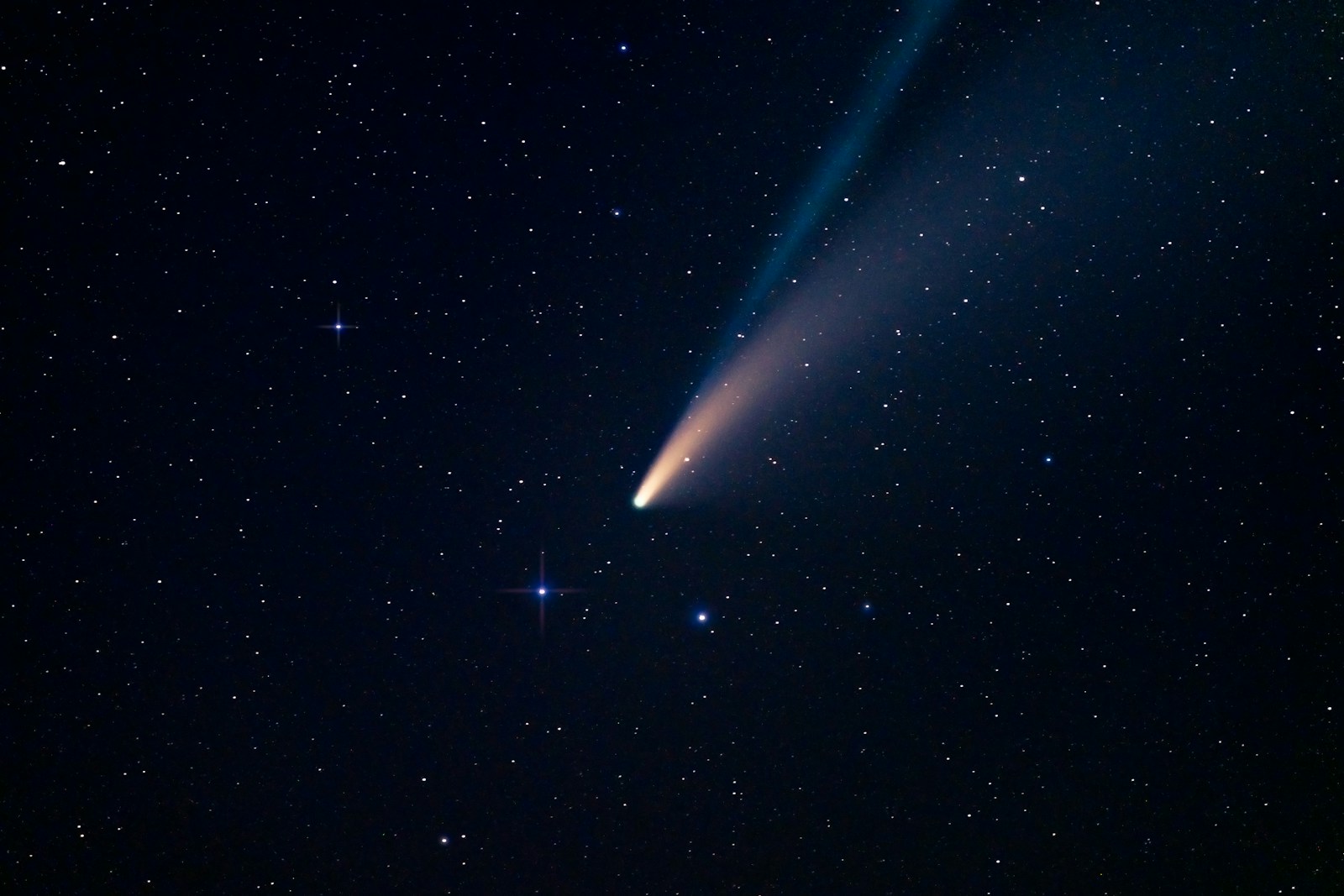
Every once in a lifetime, the universe sends us a visitor — silent, icy, mysterious — travelling for millions of years through the endless dark before brushing past our tiny solar system.
In June 2025, astronomers detected a faint but unusual streak of light cutting across the sky. The automated telescope network ATLAS flagged it first.
What looked like a typical comet turned out to be something far rarer:
👉 An interstellar comet — only the third ever discovered.
And it was named Comet 3I Atlas.
What followed over the next few months was a mix of scientific excitement, global fascination, and a deep sense of awe at how small — and how connected — we are to the larger universe.
The Discovery: A Signal From the Stars
The comet was spotted by ATLAS (Asteroid Terrestrial-impact Last Alert System), the same survey system that scans the night sky for potential Earth-impacting objects. But this object behaved… differently.
Unlike typical comets:
- Its speed was extremely high
- Its trajectory wasn’t bound to the Sun
- Its composition signatures looked unfamiliar
- Its eccentricity value was greater than 1 — meaning it wasn’t from our solar system
Astronomers quickly confirmed the thrilling truth:
💫 It came from another star system.
Just like ‘Oumuamua (1I) and Comet Borisov (2I), 3I Atlas became the third known interstellar object to pass through our cosmic neighborhood.
Why 3I Atlas Amazed the World
1. It Carried the Oldest Ice Humans Have Ever Seen
The comet’s surface contained molecular signatures older than our solar system — potentially billions of years old.
For scientists, this was like opening a time capsule created before the Sun existed.
2. Its Tail Was Breathtaking
As 3I Atlas approached perihelion, its tail became unusually long and luminescent. Photos from professionals and amateurs alike flooded the internet.
For weeks, skywatchers could see a soft, shimmering plume stretching across the night sky.
3. It Moved Differently Than Any Known Comet
Its path curved gracefully through the solar system, but it never slowed enough to be captured by the Sun’s gravity.
Instead, it flew past — a guest, not a resident.
Its speed and path gave astronomers a rare chance to test new orbital modeling algorithms.
4. It Triggered a Global Conversation About Life Beyond Earth
Interstellar objects carry materials from other star systems.
Some researchers even debated whether such comets help spread building blocks of life from system to system — an idea called panspermia.
While 3I Atlas showed no signs of biology, it reignited curiosity about cosmic origins.
The Story of Its Journey: A Visitor Passing Through
Imagine a chunk of frozen rock and dust, formed around a distant star billions of years ago.
Then something happened — maybe a planetary migration, maybe a gravitational jolt from a passing star — and it was thrown into space.
For millions of years, it wandered, alone, through the interstellar void.
Then one day, it drifted close enough to be caught — not by gravity, but by our telescopes.
As it entered our system, sunlight warmed its ancient ice, releasing gases that formed its glowing tail.
People across the world watched as it made its closest approach in October 2025.
And then, as quietly as it came, it left — continuing its journey into the cosmic dark.
A visitor that didn’t stay, but one that reminded us of just how big, beautiful, and mysterious our universe is.
Conclusion: A Moment That Connected Us All
Comet 3I Atlas wasn’t just a scientific event — it was a human one.
For a few months in 2025, millions of people looked up at the same sky, chasing a streak of light older than our sun.
Scientists studied it. Photographers captured it. Children made wishes on it.
It passed by us briefly, but the sense of wonder it left behind will last for decades.